Milverton
Concert Society

Voces8 --- Saturday 14th May 2022
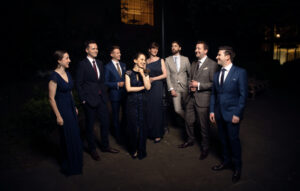
Many different moods and breath-taking moments permeated this excellent concert, experienced by an audience of mesmerised hundreds in St Andrew’s, Wiveliscombe. In addition to the beautiful sound, the superb musicianship and the dazzling technique of the singers, it was often the vitality and humour that shone out.

From the outset it was evident that Voces8 were offering us not just an evening of the very best choral singing to be found anywhere, but also a hugely special and uplifting immersive experience.

The first few notes of Byrd’s “Laudibus in Sanctis” (based on psalm 150) established a lively, clear precision, perfect for this richly-textured music which responds so well to a light, dance-like approach. We could easily have been listening to a madrigal here. But how did Voces8 achieve such a refreshingly different performance?

One clue is that Barnaby Smith, the group’s Artistic Director, confesses to being inspired by the Swingle Singers (also eight voices) (Voces8 treated us to a Swingle arrangement of Bach’s Bouree after the interval) – the influence is particularly evident in their rhythmical approach. Voces8 begin “Laudibus” in pretty much the same tempo as other world-class groups, with similar precision – but with tangibly more bounce. That’s done by singing the important syllables more strongly than others (instead of an equal emphasis) just as we do when talking. It instantly gives drive and interest to every phrase.

And then there’s the obvious enjoyment on the faces of the singers. They seem to know the music so well that each singer appears completely relaxed and at one with the line being sung – it’s as if the music has come to life and is singing itself. But at the same time, of course, they serve up a perfect balance and blend (which enhances the many exquisite scrunches, such as those in the Schutz “Selig sind die Toten”).

The group’s trademark silky smooth legato featured in many pieces – notably in the spine-tingling Rheinberger “Kyrie”, performed with gorgeous purity, and in the gentle ebb and flow of Kevin Allen’s “O sacrum convivium”. Jonathan Dove’s “Vertue” immersed us in a dark world of low sustained chords and a less familiar harmonic language. “Stardust” by Taylor Scott Davis positively shimmered.

In the inspiring afternoon Workshop, by the way, the group – affably led by Barnaby – demonstrated many nuances and techniques of voice production and breath control (and they gave us an insight into how they manage without a conductor). Their seamless transition from a warm pianissimo to a gentle hum was especially impressive. The hundred odd participants were encouraged to try some of this out in a fairly respectable performance of “Underneath the Stars” by Kate Rusby. It didn’t come anywhere near the rhythmic precision or dynamic variation of Voces8, but it was a privilege to sing along.

The second half of the concert included several very slick jazzy excursions, sometimes with added choreography. We were treated to some great crooning, close harmony and scat singing. I particularly enjoyed the twinning of “Come fly with me” and “Fly me to the moon”.

The evening had everything: awesome musicality under total control, an infectious sense of fun coupled with the greatest respect for fine music – and above all in every piece a sublime ensemble. Thank you Voces8 and thank you the Milverton Concert Society!

Review by Tom Morrell
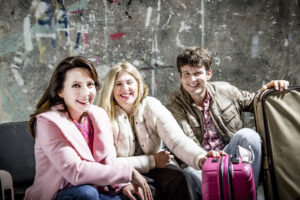
Metamorphses trio

The concert given by the Metamorphses trio as part of the Milverton Concert Series was an absolute delight and was greatly enjoyed by the audience. Comprising the idiosyncratic, though utterly compelling, combination of clarinet (Jean Johnson, American born now living in Scotland), viola (Dutch born Roeland Jagers) and piano (Crimean born llona Timchenko), this unlikely sounding ensemble treated us to three classics of the genre by Mozart, Bruch and Francaix, as well as introducing two contrasting, though thoroughly accessible, contemporary pieces for the same forces. The three players are close friends, and this translates musically into impeccable ensemble playing: not only are they consummate masters of their instruments – technically flawless – they are also in total musical harmony. This was immediately obvious from the opening, beautifully sculpted, phrases of the selection of three pieces they played from Max Bruch’s Acht Stücke op 83. Jean’s sweet-toned clarinet, Roeland’s rich viola sound and IIona’s limpid piano playing could not have been more perfect for these delightfully lyrical, though understated, miniatures.
One of the many striking aspects of the program was that three out of the five works were penned by composers over the age of eighty proving the adage that ‘music is the place where you never grow old’ (as a musician in my sixty’s this is reassuring!). Such is the case with Marcus Brunt’s Two Serenades, re-arranged by the composer for the Trio’s instrumentation: lyrical musical evocations respectively of the Gower coast and Venice’s Grand Canal. The trio vividly brought these enchanting soundscapes to life leaving one hungry to discover more of this Birmingham born composer’s music.

Mozart’s “Kegelstatt” Trio K.498 was the first work written for this unusual combination of instruments and is patently a masterpiece. The work’s title translates as “the trio composed while bowling” and we were truly ‘bowled over’ by it. The piece is chock full of memorable melodies and imaginative textural interplay between the three protagonists which the trio’s members clearly revelled in. Particularly mesmerising was Ilona’s fleet and delicate virtuoso piano passagework in the finale, despatched with ease. It was an enchanting way to bring the first half to a close.

The interval over, we were immediately ‘Going Dutch’, the title of an inspiring video documenting how this resourceful trio creatively kept music alive during covid, doggedly preparing, via WhatsApp and Zoom, for their 2021 world premiere of contemporary Dutch composer Theo Loevendie’s Metamorph. In March 2020 the trio were on tour in Spain and, living in three different countries, it would be one and half years before they could meet in person again. What a privilege it was, then, for us to be able to see them live in Milverton and to hear the trio’s committed and persuasive performance of the 91-year-old composer’s work, with its intriguing hints of jazz, Stravinsky, and Turkish exoticism.

The work that I was probably looking forward to most before the concert was Jean Francaix’s Trio and it did not disappoint. Dating from 1990 and composed by an artist in his eighties, it is full of youthful spontaneity, parodied tangos one moment, burlesque marches the next, by turns melancholic, whimsical, effervescent, anarchic, sensual and comic: dizzying musical metamorphoses performed with effortless ease and élan by the stunning Metamorphoses Trio. Please come back!

Review by Julian White

NOT HEAVY METAL

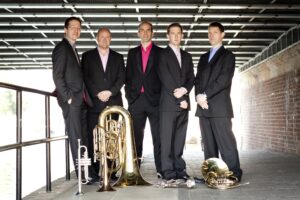
It’s really gratifying to see the audiences coming back to live performances this year, and the most recent offering from the Milverton Concert Society saw a very large turnout for the excellent Onyx Brass ensemble. There was also a teaser in Danny Clark-Lowes’ introductory remarks, in that he hinted that next time we might see a return to the much-enjoyed interval wine and nibbles – that should boost the numbers!

The five players of the Onyx group have a well-established reputation and following and it’s easy to see (and hear) why. From the very outset of the evening their sound was well-balanced, sonorous and beautifully blended, not an easy thing to achieve from instruments with very different timbres (two trumpets, French horn, trombone and tuba). Early music by Rameau and Couperin opened the evening, stately and rich-sounding in the former, forthright, even jaunty in the latter. Bach was next and we heard a lovely arrangement of the chorale ‘Nun Komm, der Heiden Heiland’ (‘Now come, Saviour of the heathens’) the opening of a cantata written for Advent Sunday 1714 in Weimar. I loved the tuba walking bass, and the ‘scrunchy’ suspension chords from the two trumpets were a joy.

Two very different fugues in A Flat Major then followed, by Bach and Shostakovich (well, they would be different wouldn’t they!) Andrew Sutton’s horn playing in this masterly Bach performance was particularly outstanding. The clarity of the lines in the Shostakovich was superb – this piece is rhythmically terrifying in places, and A Flat is not always evident!

Vaughan Williams’s Fantasia on a theme of Thomas Tallis is of course very well-known, but Onyx presented another one, written apparently in great haste on a bus journey by the then 14 year old composer Tim Jackson. We heard Tallis’s original theme as a trombone solo, followed by a lovely SATB arrangement. The Fantasia section was multi-layered, shifting chromatically all the time – Tallis’s tune was heard in a fragmented, kaleidoscopic presentation throughout and this was a tour de force. James Maynard’s ‘Fanfare’ followed, with a majestic, heroic opening slightly reminiscent of the famous ‘Star Wars’ music, and the whole piece was laced with ‘interesting’ harmonies, very few of which would have been possible on non-valve natural instruments.

Malcolm Arnold is noted for his wonderful composition for brass and we heard his Quintet No. 1 in three movements. The opening Allegro Vivace produced some brilliant, beautifully articulated trumpet playing, positively romping along. That said, this movement did have a few moments where the impetus was slightly lost from time to time, by the horn and the tuba, but this was only momentary. The sombre opening of the second movement in octaves from horn and tuba was gorgeous, and followed by mysterious shifting tonality and impassioned outbursts. The finale was virtuosic – jazzy, with wild scoopy interjections from the trombone and sinuous winding themes on muted trumpets. I loved the wild, galloping coda, superbly played.

Imogen Holst’s ‘Leiston Suite’, five very short movements written for a school ensemble, was given great advocacy by Onyx, and their performance showed that this is a composer who deserves a much wider appreciation. I particularly enjoyed the final March, a rumbunctious piece with a slightly nautical feel to it.

And now for something completely different, as they say! Laying their instruments aside, the players delivered three humorous ‘poems’. The first was nothing more than a huge number of utterances of the word ‘Me’ in various ways, seemingly at random with no structure – however I found myself surreptitiously moving my hand in a straight 4/4 rhythm and finding that it all fitted! ‘On Going to Meet a Zen Master in the Kyushu Mountains and Not Finding Him’ was the verbal equivalent of John Cage’s 4’ 33” – not a sound and variety of bizarre attitudes. Anyone coming into the venue at this point would have assumed they were all barking mad, which fits very nicely with the third poem ‘A Diary Entry by Mrs. Darwin’ by Carol Ann Duffy, where the Onyx five shouted various simian yelps and calls, in perfect rhythm with amazing control.

Back to the music, and the languorous harmonies and dreamy phrases from muted trumpets, the laid back and lush sound of Mark Nightingale’s ‘For Rosie’ was real treat. This wonderful evening finished with two gorgeous arrangements of two well-known Gershwin tunes, ‘The Man I Love’ and ‘They Can’t Take This Away from Me’. Wonderful playing and a wonderful end to the night.

Keep it up MCS – we love it and want more of it.

Review by Harold W. Mead

MY FLABBER IS TOTALLY GASTED

Occasionally a concert-going event comes along which sticks in your mind and will always be a source of awe and wonderment.  I’ve had a few of these in my lifetime but I didn’t think that I’d get another one in Wiveliscombe Church.  (No offence to Wivey, but most of my earlier ones have been in places like the Royal Festival Hall or in Vienna!). Last Saturday’s presentation by the Milverton Concert Society of the internationally famous ‘rock baroque’ group Red Priest is the cause of my latest epiphany moment.  These four musicians, taking their name from the nickname of one of their heroes, Vivaldi, gave a performance which has almost left me lost for words – not a useful state to be in when there’s a review to be written.

As they said in their programme notes, the word baroque can mean ‘irregular, strange, bizarre, florid, over-the-top and extravagant’.  Funny that, those words just about describe the players – Piers Adams on recorders, Adam Summerhayes (violin), Angela East (‘cello) and David Wright on harpsichord.  They are enthusiastic advocates for the music of the great Baroque composers like Vivaldi, Bach, Albinoni, Telemann and others and they do so with a virtuosity and élan which leaves their audiences breathless.  They started off the evening with a Vivaldi concerto, originally for four violins, but arranged by the group for themselves, and my immediate reaction was WOW!  Piers’ mastery of just about every variety of recorder (including playing two at once in harmony) was stunning as was the tightness of the ensemble.  This was sheer exuberance and flamboyance, especially the outrageous coda to the last movement where Piers’ fingers on the descant recorder were a total blur.

They then proved that they’re not all flash and showmanship by playing a lovely arrangement of the Adagio from Bach’s ‘cello sonata in G minor.  The sound of Angela’s period instrument and bow, using minimal vibrato was wistful and elegiac and when Piers joined in on the tenor recorder the ensemble sound was just perfect.  Albinoni was next, a composer most famous for a piece he didn’t write, and the jaunty opening gave another opportunity for recorder fireworks.  Again, the lovely Adagio movement was treated with great affection, the lovely violin and ‘cello opening being joined by an equally soulful recorder melody.  A furious presto finale was thrown off with great aplomb and insouciance.

The next item, “L’ Amiable”’ by Royer was introduced as ‘a bit like French café music’.  I see what they meant;  Adam playing on a wind-powered reed keyboard did sound rather accordion-like, but ‘Allo, allo’ this wasn’t.  It was a pastorale piece, and when the bass recorder was added to the strings its mellow tone was very effective.

I confess never to have heard of composer Henry Eccles (1670 – 1742) an Englishman who mostly worked in France.  The Adagio and Presto from his violin sonata No. 11 arranged for ‘cello were given a sympathetic outing by Angela and David, the exuberant Presto ending on two triumphant pizzicato notes played with great relish.  Similarly Gaspar Sanz (Spain, 1640 – 1710) is not particularly well-known, but his ‘Canarios’ was a good introduction to his work.  Adam played a small guitar, also using it as a drum, and the piece sounded very like a peasant dance.  It required great agility once more from Piers and after many key shifts finished with a virtuoso coda on the sopranino recorder.

Bach’s 5th Brandenburg Concerto is famous for being the one where the harpsichord is allowed a furious solo cadenza in the first movement instead of merely being the background accompaniment.  They started the piece off at a tempo a bit faster than I’ve usually associated with the ‘normal’ orchestral arrangement, but here were four formidable soloists who had no difficulty whatever with its demands.  This was a relentless, constant flow of melody leaping from instrument to instrument, and the harpsichord cadenza, stunningly played by David wasn’t allowed to grab all of the spotlight!  It was ‘interfered with’ by everyone else adding ad hoc contributions, and the whole thing was masterful.    The second movement was taken at a more ‘conventional’ tempo, with lovely balance between the four instruments.  I was struck by the lightness and agility in the ‘folk dance with fugues’ third movement.  I’m pretty sure this was the sort of sound that would have been heard in Bach’s time.

Finally we heard the group’s take on Tartini’s ‘Devil’s Trill’ sonata.  This may be described as ‘based on’ that work – as they said in their introduction, they have included a tango, and a duck makes an appearance too!  The spooky opening led into the tango – pizzicato violin and ‘cello overlaid by incredible recorder roulades over the strings.  The duck did arrive, by virtue of some raucous ‘sub ponticello’ (below the bridge) scrapes from Adam and we were then led into a furious coda whose varied episodes once more left us awestruck.  The applause was long, loud and utterly well deserved.  There was no way they were going to escape without an encore – this we got, in the form of the short and very jolly ‘Jews Dance’ arranged by Red Priest from music by Richard Nicholson (1563-1639) – again a positive cascade of notes played at breakneck speed.

What more to say?  This was a stunning evening, played by stunning musicians.  All I can say to Milverton Concert Society is ‘follow that if you can’.  Knowing them, I’m sure they will.  Roll on 2022!

Review by Harold W. Mead

71.4% OF EXCELLENCE

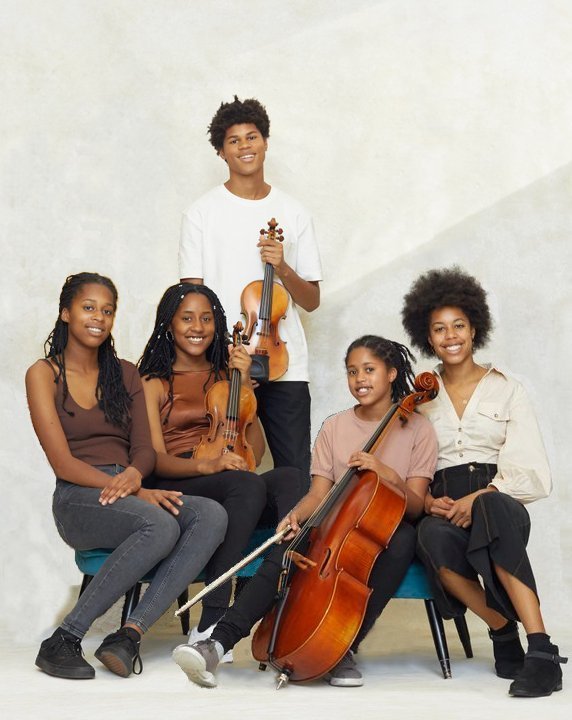
That’s not a critical statement – it’s a simple arithmetical expression in that the audience at the Milverton Concert Society’s concert last Friday evening heard five sevenths of the astoundingly talented Kanneh-Mason family.  The concert actually took place in St. Andrew’s, Wiveliscombe, presumably because of the expected numbers, and there was certainly a very large house for the event.  The programme was relatively short and there was no interval, but it was a very entertaining concert with a real ‘wow’ factor about it.  Two of the seven Kanneh-Masons, ‘cellist Sheku and pianist Isata, were abroad, pursuing their burgeoning solo careers, but their siblings did the family proud.

The concert opened with violinist Braimah and pianist Konya playing the first movement of Grieg’s third Sonata.  The dramatic opening was delivered with great assurance, but I felt that the balance of the two instruments was significantly tilted towards the piano.  True, the piano writing is quite heavily scored, but the violin part should have been more prominent.  Perhaps a bigger-voiced instrument would suit Braimah better, but there is absolutely no question about his talent and skill – this was a lovely performance.  The first of two programme changes followed – instead of the expected Bartok Suite Op. 14 (which Konya did play at the afternoon performance) we were treated to a lovely rendition of the limpid and rippling Impromptu Op. 90 No. 4 by Schubert.  This was gorgeous, Konya’s crystal clear articulation letting us hear every note to perfection.  The darker and dramatic second section did once or twice sound a little over-pedalled but I’m just being picky – this was lovely music making. 

Next we heard Jeneba, Aminata & Mariatu playing the second movement of Mendelssohn’s 1st Piano Trio.  The piano intro was glorious, reminiscent of the composer’s lovely ‘Songs Without Words’, and the balance and ensemble sound when the strings joined in was just perfect.  This balance, and scrupulous attention to the composer’s dynamics, was beautifully maintained throughout.

Aminata (violin) & Jeneba (piano) then gave star treatment to the 1st movement of Mozart’s lovely Violin Sonata No. 18.  There were no balance problems here and Aminata’s singing tone was truly lovely.  Mozart’s writing here is among his best, and the performance was brilliant throughout. 

Sadly we then had another programme change – instead of Elgar’s ‘Sospiri’, Braimah and Konya played ‘Sea Murmurs’ by Castelnuovo-Tedesco (a composer whose name translates as ‘German Newcastle’!)  This is a slight piece with muted violin figures over rippling arpeggios from the piano.  Well played, but no substitute for the wonderful Elgar work it replaced. 

Rachmaninov’s ‘Elegie’ then followed, giving ‘cellist Mariatu, the youngest Kanneh-Mason, the spotlight.  Her sonorous, heartfelt opening statement of the tune was lovely, and she showed real passion in the middle section.  We were left with a feeling of repose and resolution on the return of the first tune and this lead to a tranquil ending of a very fine performance.

The final item on the programme was Liszt’s barnstorming Hungarian Rhapsody No. 2, probably the most famous and oft-played piece he ever wrote.  (Even Tom and Jerry have played it in the award-winning ‘Cat Concerto’ cartoon.)  Jeneba took the piece by the scruff of the neck and gave us a thunderously abandoned yet brilliantly controlled performance of this old warhorse.  The prestissimo octaves at the end, leading to the manic conclusion were stunning and the whole thing was a tour de force.

There was no way they were going to get away without an encore, and all five of these marvellous young people joined in their own arrangement of the well-known ‘Czardas’ by Vittorio Monti.  Special mention must be made of Braimah’s flawlessly played high harmonics in the middle section and the ensemble romp to the end prompted a well-deserved standing ovation (yes, in Wiveliscombe) from the audience. 

This is an amazing family and we must thank Milverton Concert Society for giving us the opportunity to hear them.  It was a privilege to be in the same building as them, and they did us proud.

Review by Harold W. Mead