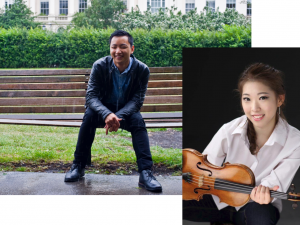
 The Milverton Concert Society can always be relied upon for two things – presenting exciting concerts to the highest professional standard, and also encouraging and promoting the young, new artists of tomorrow. Last Friday they combined both in their annual ‘Young Musicians Platform’ concert, and what an evening it turned out to be.
Starting a little earlier than usual (and just as well – it turned out to be a bit of a marathon) the first part of the evening was a showcase for six young performers. Each of them in his or her own way demonstrated not only talent but the determination to succeed which is the mark of the future true professional.
Clarinettist Olivia Wade played the Prelude from Paul Reade’s ‘Kitchen Garden Suite’ (1991), with Rachael Parvin providing very good support and collaboration from the piano. Olivia’s phrasing and attention to dynamics were just right and this was a lovely performance. Theo Topham then took over the piano, to play Catherine Rollin’s ‘Sunrise on the Matterhorn’ which sounds much more advanced than its Grade 3 classification would suggest. Theo’s positive and sonorous playing of the opening rising arpeggios told us that here was an already accomplished musician and his lovely phrasing throughout confirmed this.
The flute next, with Stephanie Vellacott playing a Corelli Gigue – her playing was very controlled and accurate and there is no doubt that as she advances with her studies, she will be a fluent and eloquent champion of her instrument. ‘Something completely different’ was then provided by Spike Maxwell, whose unaccompanied performance of the folk song ‘Geordie’ really captured the pathos of the young girl pleading for her condemned love – Spike was pitch-perfect and his diction was exemplary. His second song could not have been more different, the sardonic ‘Poor Unfortunate Souls’ sung by the character Ursula in ‘The Little Mermaid’. His characterisation and communication were fantastic and it was obvious he was right in his comfort zone!
Saxophonist Otis Ubaka’s performance of Duke Ellington’s ‘In a Sentimental Mood’ took us right into the smoky atmosphere of an American jazz club – what a gorgeous, mellow tone he produced, and once more Rachael Parvin on piano provided a perfect partnership. As she did too, with obvious enjoyment for Otis’s second piece, the spiky ‘Work Song’ by Cannonball Adderley. Otis managed to make the terrific middle section sound improvised, but he knew exactly what he was playing and did it splendidly.
Finally we heard soprano Anna Garbutt in an ambitious programme which could not have held greater contrasts in style. In Gluck’s ‘O Del Mio Dolce Ardor’ she suffered a couple of brief memory lapses, but despite her nervousness she held it together and in her next item, one of Purcell’s most famous arias ‘Dido’s Lament’ she conveyed the emotion of the piece extremely well. The Air was nicely phrased but could have been a bit more smoothly legato. To finish with Mozart’s equally famous and florid ‘Alleluia’ was very brave and ably assisted once more by Rachael, Anna sang spiritedly and well. The runs were a little wayward in places, but nervousness would account for that.
All in all, these six performances spoke volumes for the wonderful work being done by music teachers all over the county. MCS are to be congratulated for pulling this wonderful concert together and for the future of music in Somerset I hope they will go on doing so for years to come.
The second part of the evening brought back to Milverton two artists whom have previously graced the stage there when they were both not far from the age group of the six musicians I’ve just written about. Then, seven years ago (I was there!), pianist Weng Soon Tee and violinist Julia Hwang were 18 and 17 respectively and are both now firmly established in their professional musical careers.
Julia started with the spiky and astringent Poulenc Sonata for Violin and Piano – her collaborator on the keyboard (I refuse to say ‘accompanist’ – these were two equal musicians) was Charles Matthews and between them they gave a stunning performance of this 1942 work. I was so entranced by the playing that I soon deemed it totally unnecessary to make any critical notes – this was as good as it gets. I was particularly impressed by Julia’s impeccable double-stopping in the second movement and her jaw-droppingly accurate pizzicato in the third.
Beethoven’s Sonata No. 8 Opus 30 No. 3 was next (she played that seven years ago!) and again the perfect rapport between violin and piano meant that all I had to do was sit back and wallow in the beauty of it all.
She finished with igor Frolov’s ‘Concert Fantasy on Themes from Porgy and Bess’ a glorious arrangement of the best-known tunes from Gershwin’s masterpiece. Charles made the most of the lush (and probably fiendishly difficult) piano part, and Julia was wonderfully right in the musical idiom. Her playing was technically superb – ‘Summer Time’ on high harmonics for goodness’ sake! Again her plangent double-stopping brought out the jazz flavour of the piece and her playing of the gloriously ornamented ‘Ain’t Necessarily So’ and ‘I got Plenty of Nothing’ made we want to jump up and dance around. (I am of course far too staid and controlled to do any such thing). This performance by both artists made demands for an encore quite inevitable, and a lovely arrangement of Debussy’s ‘Clair de Lune’ followed.
So did the interval and a much-needed glass of wine.
The Sonata Op. 2 No. 2 is an early work, written only four years after the death of Mozart, but it could not be by anybody other than Beethoven. Weng Soon Tee played the opening movement with flawless articulation, beautifully controlled dynamics and minimal use of the pedal. However, I’m sure Beethoven would have revelled in the sonority and power of a modern grand piano, and I like to think that Weng’s sound would have delighted the composer. The second movement brought precision but without metronomic boredom and the witty and forthright scherzo third movement wasn’t Mozart or Haydn – it was the genius of the new kid on the block. The sonata finishes in an uncharacteristically quiet and sotto voce way and Weng had started on his next piece before the audience had time to react and applaud!
This was Janacek’s ‘In The Mists’ (1912) and the work is a unique blend of the composer’s Moravian background and the musical impressionism being produced by composers such as Debussy. It is not a musical idiom which would have been familiar to most of the audience and Weng proved to be a worthy advocate for it. Again, the virtuosity he displayed generated many calls for an encore, which came in the form of Chopin’s Ballade No. 3 in A Flat. It may have been the lateness of the hour, but technically brilliant as his playing was, I felt that this performance was far too hard-driven. Even in his most virtuosic passages, Chopin demands to be able to breathe and flow in phrases. However, it was a heroic finish to what was a terrific evening of music making.
Keep going, MCS – you’re doing a great job.
Review by Harold W. Mead, 05/05/2019

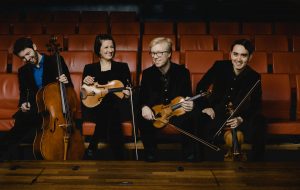 It was by misadventure that the audience at Milverton Church were treated to a magnificent concert last Friday – the evening was scheduled to be performed by the Vision Quartet, but an unhappy accident to their ‘cello player ruled out their appearance. The Marmen Quartet stepped into the breach at incredibly short notice and gave us an evening of music to remember. They are a multiple prize-winning ensemble and it’s easy to see why.
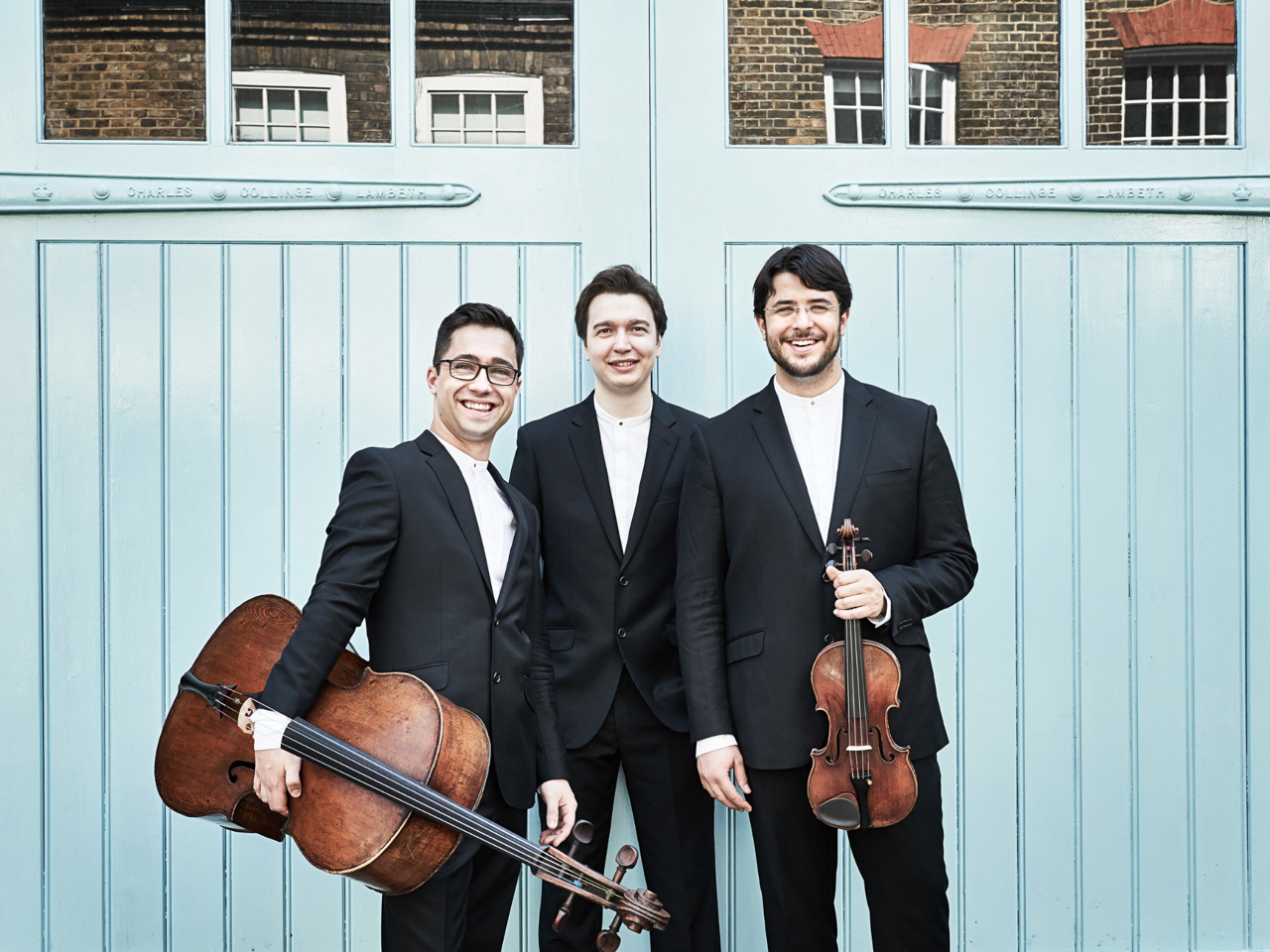 And so it was, both inside and outside Milverton Church, to kick off the 2018/19 season of the Milverton Concert Society last Friday. ‘Trio Isimsiz’ is a Spanish/English/Bulgarian trio who all speak fluently the most international language there is – music. Three young students at the Guildhall School of Music formed the trio in 2009 and from the outset have won awards and made a name for themselves. Now all Fellows of Guildhall, their appearance at Milverton was one of the happy events made possible by the hardworking team at MCS, whose skill at providing concerts of the highest quality is undiminished.