
The Usual Brilliant Start
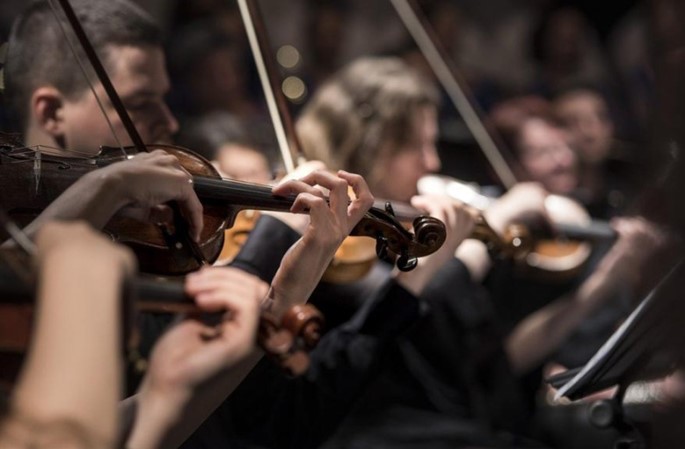 The last day of September saw a gratifyingly large audience in St. Andrew’s, Wiveliscombe for the inaugural concert of the 2023/24 season from Milverton Concert Society. The reason for the shift of venue was obvious – performing for us was the 9-strong Chamber Orchestra of the West, and the more compact performing space of Milverton Church would not have been suitable. Founded in early 2020 by Jacqueline (Jackie) Shave, the orchestra’s goal is to “create and sustain relationships with the communities of Somerset, Devon and Cornwall through our live performance. To bring great music to all the people of the three counties; to play in the prestige venues, the less visited corners and in the places where those marginalised for whatever reason can hear us.”
They presented a very varied programme, spanning many centuries and genres, and their sheer artistry and musical professionalism shone through at all times. The concert opened with what must be the oldest piece of music the audience had ever heard, from the 12th century. “O Virtus Sapientiae” (O power of wisdom) by Hildegard von Bingen is an atmospheric piece evoking the monastic life and times of long ago. The sustained string phrases, played with an almost complete lack of vibrato, were lovely and the perfect balance of the ensemble was a joy.
Also evoking times long gone, the next piece however could not have been more different. Debussy’s “Syrinx” (also known as ‘Flute of Pan’) is a staple of the flute repertoire and we were treated to a gorgeous performance from on high i.e. in the pulpit, by Eliza Marshall. Her limpid tones coupled with impeccable phrasing evoked mythological times and it was a musical tour de force.
Estonian composer Arvo Pärt was next; his “Fratres” (Brethren) was composed in 1977 without any specific instrumentation defined. Muted strings were Jackie’s choice and we heard an ethereal sound from the upper voices over a lower ground. Forthright ‘cello pizzicato interjections divided the set of variations and as the piece proceeded the texture was built up layer by layer. We heard a beautifully solid ensemble sound but with absolute clarity of the individual lines. The modality of this piece harked back to the von Bingen, and also in places I could hear hints reminiscent of the Vaughan Williams ‘Tallis Fantasia’. From comments at the interval I gather this work was not everyone’s cup of tea, but I enjoyed it greatly.
Another contrast followed with Faure’s “Après une Rêve”, a dream of a romantic flight with one’s lover away from the earthly mundane. Joely Koos produced a gloriously lush and soulful ‘cello sound, and she played the piece with great passion.
Leaping backwards once again, Purcell’s Fantasia is C Minor starts with very sparse writing for the strings, the early pages producing quite astringent harmonies/clashes. The faster second section took us into a more comfortable soundscape and once more the perfect balance and clarity of line was evident.
Peter Warlock’s “Capriol Suite” is very well known and we were treated to an energetic opening with a gloriously solid ensemble sound under perfect control. In the Pavane we had elegance with poignancy, sheer joie de vivre in the Tordion (brilliant pizzicato!), urgency and élan in the Bransles, wistful dreaminess in the Pied en l’Air and almost ruthless, driving, uninhibited energy in the final ‘Sword Dance’. A great performance.
Not only is Jackie Shave a first class performer, but also a composer, and the first half of the concert closed with her ‘Leaving my Homeland’ and ‘Machair to Myrrh’. These pieces had me listening intently, trying to pin down the ethnic sources of the melodies and timbres – is that Middle eastern? Oh, wait, no that’s definitely Celtic. Hang on that sounds a bit like port à beul (Gaelic ‘mouth music’). All pointless really; eventually I just enjoyed the very well-crafted music, especially the North African modality at the end – spiky, slinky and full of brilliance.
I was so touched at the interval – having made complimentary remarks in an earlier review about the cheesy bread sticks, I found that the Society had put aside and closely guarded some for me to enjoy with my glass of wine. Thank you!
The second half began with the Sonderho Bridal Trilogy, string versions of Danish folk melodies. The orchestra’s setting was based on the Danish String Quartet’s arrangement of these traditional tunes, and they transferred wonderfully to the larger ensemble. The sound idiom was quite modern but the old Scandinavian influence was very clear, reminiscent of Shetland fiddling in places (no surprise). I loved the exciting cross rhythms of the ‘cellos under the melody from the upper strings in the second piece. The third piece had a lovely wistful violin tune over a fragmented ‘cello accompaniment, the tune then morphing into a more free-flowing version before the beautifully tranquil end.
Bach’s fifth Brandenburg Concerto is famous as ‘the one where the harpsichord player goes berserk’. At the opening of the concert we were told that sadly the orchestra’s usual harpsichordist Pawel Siwczak was unable to play due to a sprained wrist (probably from practicing this piece!) and that by good fortune Anhad Arora (a PHD student at Merton College, Oxford) was available to fill the gap. The opening was once again a lovely example of the orchestra’s scrupulous attention to perfect balance, Eliza’s flute both blending and rising above the texture exactly as required. When it came to the harpsichord ‘cadenza’, Anhad unleashed a torrent of notes flawlessly played – I almost could not believe how so many notes could be played so quickly yet sound perfectly under control – bravo!
In the second movement the violin/flute/harpsichord trio was beautifully balanced and it was joy to listen to. By now of course I had put my reviewer’s notebook away and was just listening – the jaunty dance rhythms of the finale were beautifully executed.
The concert ended with “Stomping Song” by Varess. Jackie did say that this was the piece that demanded the greatest concentration from the players – I could see why, it’s rhythmically terrifying. The piece has a definite mid-European/gypsy/Hungarian feel to it and the sheer energy the orchestra put into it left me exhausted, never mind the players! The applause was prolonged and heartfelt – this was a great evening of music making and once more showed just how adept the Milverton Concert Society is at sourcing the very best for our musical entertainment.
Review by Harold W. Mead
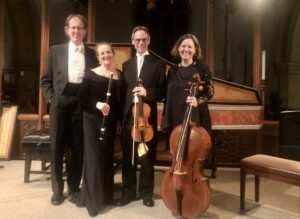 A hardwood flute, gut strings, baroque bows and a magnificently ornate harpsichord were clear signs of a musically authentic evening In Milverton Church last Friday. A gratifyingly large audience was there to hear the prestigious and greatly talented London Handel Players, who led us unerringly through an evening of 18th century masterworks played in an equally masterful way.
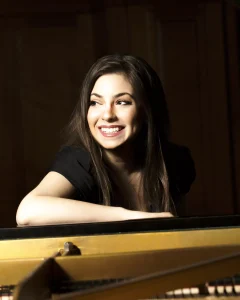 The Milverton Concert Society is the gift that keeps on giving, nourishing its enthusiastic and loyal audiences with one musical feast after another. The latest sell-out aural banquet was no exception, given by the prodigiously talented, virtuoso British-Turkish pianist Lara Melda who, aged only 16, was catapulted into stardom when she won the 2010 BBC Young Musician competition.
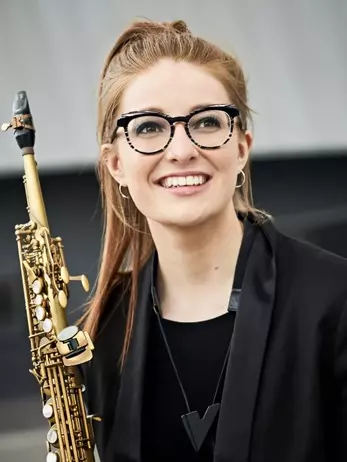 I’ve said it before and I’ve got to say it again – Milverton Concert Society puts on the most superb concerts and gives us the privilege of hearing an amazing array of musical talent of the highest quality, time after time. They did it again today (Sunday 5th Feb) when a totally sold out, jam packed St. Andrew’s in Wiveliscombe heard the stunning performer that is Jess Gillam in a wonderfully varied programme.
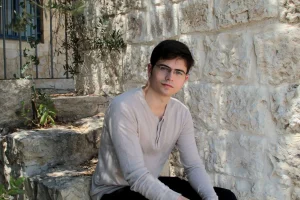 What a privilege it was to hear the young Jerusalem-born, multi-prize-winning pianist Ariel Lanyi perform in the delightful setting of Milverton’s candle-lit St Michael’s Church. On the evidence of this memorable concert, Ariel clearly has a stellar career ahead of him.