Milverton
Concert Society

A Championship Performance
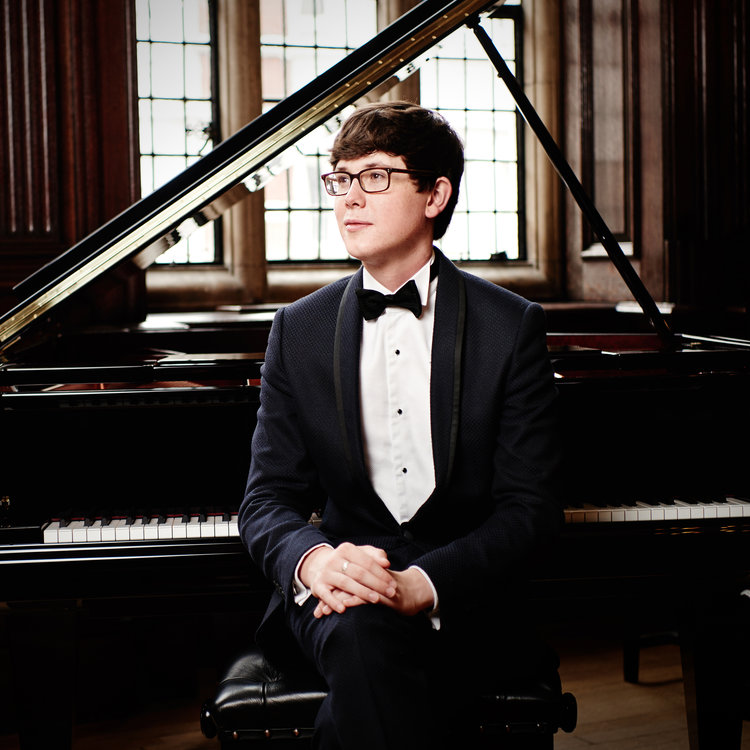
I went to the latest Milverton Concert Society’s event straight from having watched Day 3 of the Open Golf Championship.  I had seen young Collin Morikawa (the ultimate winner) exhibit sheer professional precision, but complemented by flexibility and a wonderful ability to adapt to changing requirements.  Then I came to Milverton and saw pianist Martin James Bartlett do exactly the same thing – spooky, eh?

MJ (I hope he won’t mind me calling him that) is a regularly welcome visitor to these parts, and his relatively short concert (Covid constrained) was another demonstration of his brilliant talent.  Two Bach pieces opened proceedings – one of his choral preludes for organ (transcribed for piano by Busoni) and the evergreen ‘Jesu, Joy of Man’s Desiring’, arranged and frequently performed by Dame Myra Hess.  In the first, his brilliant use of the sustaining pedal produced an almost organ-like flowing legato.  The totally familiar ‘Jesu, Joy’ came up sounding totally fresh – I was interested to see that the arrangement incorporated one of Liszt’s tricks, playing the slow melody with the thumbs while the rest of fingers produced the faster accompanying figures.  Needless to say, MJ played it beautifully.

Contemporary with the Bach we next heard Rameau’s Gavotte and Variations from 1727.  It started off with the typical trills and flourishes of the period built on top of a short melody which formed the basis of the variations.  MJ’s performance was much enhanced by his exploitation of the wider dynamic range of a modern piano, a facility not available to the composer on his harpsichord.  Throughout I was delighted by the crystal clarity of line and the whole performance was full of genuine joie de vivre.

This élan and energy was also evident in Haydn’s Piano Sonata No. 31 in A Flat.  I can’t help feeling that Haydn had his tongue firmly in his cheek when he threw in so many short, quirky and ‘off the wall’ phrases in the first movement and it was obvious that MJ relished them too.  The measured sonority of the slow second movement was beautifully rendered and gave us a sense of tranquillity rather than melancholy.  The finale was sheer exuberance from start to finish, both in the writing and MJ’s playing.  In places I thought I could hear where Beethoven might have got some ideas for his early piano sonatas. 

The gear change required to go from Haydn to Chopin was expertly managed by MJ and I immediately found myself in a 19th century salon hearing the master of romantic piano writing being given a truly masterful rendering in the lovely Nocturne in D Flat from the composer’s Opus 27.  MJ is obviously ‘simpatico’ with Chopin and I’d love him to bring out an album – it would sit proudly on my shelves beside the older masters like Vasary and Ashkenazy. 

Some of Liszt’s transcriptions of other composers’ work can be a bit OTT, but for the most part he gets it right.  We heard a lovely performance of Schubert’s famous ‘Serenade’ where the song is presented first in the treble register (Soprano), then an octave lower (Tenor) and finally in a sort of canon arrangement where the two ‘voices ‘ follow one another, brilliantly played. 

Talking of OTT arrangements, MJ’s next offering was staggeringly well played, but to be honest I wish he hadn’t bothered.  The Rachmaninov song ‘Where Beauty Dwells’ seemed to have been assaulted by Ravel and Debussy in the arrangement by American pianist Earl Wilde.  The melody was swathed in empty roulades and arpeggios and it took all of the pianist’s skill to maintain clarity in a very congested environment.  Not my tasse de thé.

On the other hand, the final item, Ravel’s ‘La Valse’ would have knocked my socks off if I’d been wearing any, both for its sheer demonic invention and MJ’s colossal performance.  From the menacing low rumbles (think ‘Jaws’) the work evolved along frenetic and sinister lines.  Yes, it’s in 3/4 time (usually) and there is a tune which could sound like it came from Vienna, but I cannot imagine any glamorous couples dancing to this.  The crashing bass chords and frantic glissandi were wonderfully played and I could only marvel at MJ’s total control over what must be the most manic ending to a piano piece ever written.  If Disney had included this piece in ‘Fantasia’ I’m pretty sure his illustrators would have set it in the depths of Hell.

I really enjoyed this concert and a huge thank you to the Milverton Concert Society for consistently presenting concerts of the highest quality even in these truly awful times.  I’m looking forward to their next two offerings, hopefully in a more familiar environment where we can enjoy the wonderful musical and social events we have come to know and love.

Review by Harold W. Mead
The Happy Return

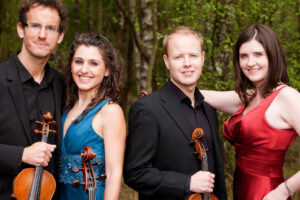
I’ve borrowed the title of one of C. S. Forester’s ‘Hornblower’ novels, and it really seems to be most appropriate for the long-awaited resumption of live concerts presented by the Milverton Concert Society.  Yes, the environment was still severely constrained by social distancing and mask wearing, but somehow that mattered little – there we were back in familiar surroundings, looking forward to live music-making once more!
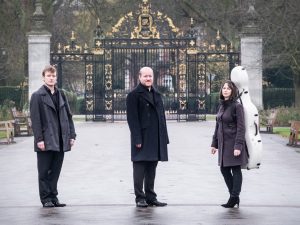
And wonderful music-making it was – an afternoon programme of Beethoven and Dvořák provided by the excellent Carducci Quartet.  The opening of the second of Beethoven’s ‘Rasumovsky’ quartets (Op. 59, No. 2 in E Minor) had us sitting up with delight.  The expansive, open sound of real instruments in close proximity made me realise just how limited we have been for over a year, downloads, MP3 files and Zoom performances notwithstanding.  The Carducci sound was a revelation, full of sheer energy and the first movement positively fizzed and crackled with élan.   The contrast provided by the Lento second movement was amazing.  An elegiac opening had a gorgeous ensemble sound, perfectly balanced.  In this movement’s darker and more dramatic sections the energy returned and it was not hard to detect Beethoven’s sadness and anger at his by then severe deafness in the writing (and the performance).  I was particularly taken by the lovely viola sound over short ‘cello figures near the end, and the way in which the final descending theme was passed seamlessly from player to player brought this movement to a lovely close.

The Scherzo has a fragmented, spooky opening, an uneasy sound which was wonderfully realised.  The obligatory Russian tune in this movement (Rasumovsky was the Russian ambassador in Vienna) was jaunty to start with, and although not the most profound of melodies, Beethoven imbued it with great character.  It was treated as a mini-fugue at first, and then developed in different styles – the Carducci’s skill in these contrasting passages was first class.  The last movement shifts to E Major, a bright and more optimistic key and it was played with joyful ebullience, even playfulness by these four top-class musicians.  They rocketed to a triumphal conclusion.

A short, wine-less interval  followed – not everything is back to normal yet!   We were then delighted by a lovely performance of what is probably the most popular of Dvořák’s compositions in this genre.  The ‘American’ quartet was composed when he was in the United States and enjoying welcome recreation in Spillville, Iowa, an enclave of Czech immigrants to America.    The opening is unmistakeably both Dvořák and American.  The immediate mood and the musical phrases suggest the huge vistas and wide-open scenery of the huge continent.  Works by later composers (such as Copland) also contain similar colours and there is definitely something uniquely American in the tonal palette.  That said, there is a decidedly Celtic quality in the sound of the second movement, and it is well known that Dvořák was very interested in how the music of the New World was being formed out of the melting pot of peoples and cultures being mixed together there. 

This is supposed to be a review of the performance, not an erudite thesis on musical style!  Let’s just say that the Carducci’s playing, discipline, energy and enthusiasm for the music made any comments about their skill and interpretation superfluous – I put my notebook down and just revelled in the sound.  The last movement in particular was precise, energetic and totally good-humoured throughout.  The duration and volume of applause produced by a Covid-limited audience size must have told the players just how good their performance was and I for one just loved it. 

The programme was repeated in the evening to allow as many people as possible to hear this fine group, a format which will be continued until all restrictions are lifted, and the Concert Society feels that it is safe to revert to the more traditional presentation.  In the meantime, brilliantly done MCS, and I’m delighted to be back.

Review by Harold W. Mead

A Triple Delight

As usual for these concerts, Milverton Church was well filled on Friday evening for the latest offering from the Milverton Concert Society, an appearance by the prestigious London Bridge Trio. Formed in 2002, the trio comprises Daniel Tong (piano), David Adams (violin) and Kate Gould (‘cello) and their concerts and CDs are always in great demand. The programme was firmly rooted in the classical and romantic genre; we heard Beethoven, Schumann and Mendelssohn, represented by three towering works in the trio repertoire. Beethoven’s very early Opus 1 Trio in E Flat opened the proceedings, and right from the off we knew we were in for a good evening’s music making. The rather Mozartian first movement was spritely, crisply articulated by all three players. The sound was gloriously full and mellow, a beautifully balanced ensemble sound.

Somebody once said. “If you want to learn discipline, don’t join the army; join a chamber music group”. This was evident immediately – the trio exhibited a wonderfully tight rapport, both in the allegro first movement and the wistful, lyrical second, a lovely adagio. The Milverton piano is a powerful, modern concert grand, but Daniel’s playing somehow produced a crisp, silvery tone perfectly suited to the music, and absolutely in keeping with the late 18th century composition. The scherzo 3rd movement is unmistakably Beethoven, with quirky shifts in tonality played with great panache, often over a lovely ‘ground bass’ from Kate’s ‘cello. The last movement calls for great virtuosity in the piano part, matched by furiously scurrying violin passages – again the ensemble sound was tight and coherent, while every line could still be heard distinctly even in the most ferocious bars.

Schumann came next, in the shape of his Trio No. 2 in F, Opus 80, composed in 1847, more than fifty years after the Beethoven. We heard an urgent, declamatory opening, again with a rich ensemble sound. The movement’s brilliant, rapid ‘cello figures were played with great bravura and the rather contrapuntal middle section gave all three players a chance to shine. The slow movement is very song-like (indeed the tune is similar to one of Schumann’s lieder) and the sense of longing in the theme was communicated beautifully. The middle section of this movement is more sparse, with tune fragments passed from player to player. These were articulated with great clarity and always with coherence. The third movement wasn’t the expected fast scherzo, more a lilting piece with more than a hint of the ländler about it. Similarly instead of a showy, fast last movement Schumann marked it ‘not too fast’ and we heard a forthright, optimistic theme played with great sonority and energy.

The interval produced the customary opportunity to catch up on social matters over a glass (or two) and we took our seats again in a warm expectant glow. We were not disappointed – Mendelssohn’s 1845 Trio in C Minor is full of energy, stormy and restless from the outset. Contemporaries of Mendelssohn remarked on how driven and furious his music sometimes was and the opening of this trio fits the description.

Here however I have to make my only slightly negative comment about what we heard. The piano part is characterised by devilishly fast semiquaver runs in abundance, and although I could SEE that Daniel was attacking these with gusto, I actually couldn’t always hear all the notes – he seemed a little too much in the background of the ensemble sound. The stormy and furious writing returned in the coda, and a wonderful end to the movement it was.

Mendelssohn is famous for his solo piano pieces entitled ‘Songs Without Words’ and the slow movement of this trio is very much in that genre. The opening piano statement is soon joined by the strings and we heard some lovely exchanges between the violin and the ‘cello. The Scherzo is rather fiendish – we often refer to Mendelssohn’s ‘fairy music’ as typified in his writing for ‘A Midsummer Night’s Dream’ – the fairies in this piece sounded a bit sinister, but the playing was superbly dexterous.

A confident ‘cello opening to the last movement led to a bold, extrovert section from all three instruments, before we reached the core of this movement. This is based on a Lutheran chorale tune, first played on the piano then taken up by the strings. David’s violin tone in this was absolutely ravishing. An impassioned central section led to a final triumphant restatement of the chorale in C Major – such was the solidity of the sound it was very hard to believe that we were listening to only three players!

I loved this concert and it was yet again a tribute to Milverton Concert Society’s determination (and success) in bringing performers of the highest calibre to play for us. The applause was long and very well-deserved. MCS are to be praised for what they do and the best way to acknowledge this is to come to their concerts and bring as many friends along as possible. You won’t be disappointed.

Review by Harold W. Mead

Leonard Elschenbroich – cello and Alexei Grynyuk - piano

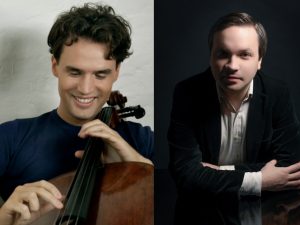
There was a sense of expectancy and anticipation among last Friday’s audience at St Michael’s Church, and they were not to be disappointed. The performers were Leonard Elschenbroich (cello) and Alexei Grynyuk (piano), and their programme included two sonatas for cello and piano by Beethoven, No. 3 in A major, Op. 69, and No. 5 in D major, Op. 102, followed by Shostakovich’s sonata for viola and piano, Op. 147, arranged for cello.
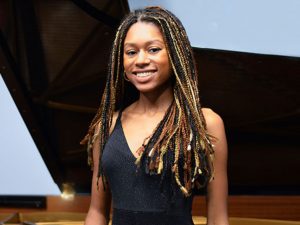
Leonard Elschenbroich has been a BBC Radio 3 New Generation Artist, and has won many awards for his playing around the world, including the Leonard Bernstein Award. Alexei Grynyuk has similarly established himself worldwide as an acclaimed soloist and chamber musician. He and Elschenbroich also play in a trio with violinist Nicola Benedetti who they met whilst music students in London.

From the start these two performers displayed a real partnership. The opening movement of Beethoven’s Opus 69 has two themes which are begun by the cello and completed by the piano, and then repeated with roles reversed, before intricate further development. They showed how Beethoven gives equal weight to each player in these late sonatas. The second Scherzo movement was full of excitement and drive. The final movement begins with an almost Mozartian adagio but then bursts into life. Both Elschenbroich and Grynyuk shone in the brilliant runs, in which Grynyuk in particular showed tremendous agility. But there were also brief slower conversational passages in which both players took almost loving care in their toing and froing, before launching into the rousing finale.

The Opus 102 sonata, written some eight years after Opus 69, is in D major, referred to by Hans Keller as Beethoven’s “rustic key”. At the time Beethoven composed it he was completing his 5th Symphony and beginning work on his 6th, the “Pastoral”, which is also in D major. In the first movement, Allegro con brio, Elschenbroich and Grynyuk made much of this rusticity with some very robust playing, which was notable again in the final movement. They paid great attention to Beethoven’s constantly changing dynamic markings, almost to the point of exaggeration, but it has to be remembered that Beethoven was suffering from increasing deafness at the time and his sudden fortissimos may have had a lot to do with his frustrations. The second movement of this sonata is the only complete slow movement in all of Beethoven’s five cello sonatas. For me this performance was just a bit too slow, so that one lost track of the themes being developed, but there was nonetheless some beautifully sustained and quiet playing from both performers leading directly into the final Allegro fugato movement, in which both Elschenbroich and Grynyuk excelled. There was again some rusticity, but things never got out of control, and there was some great delicacy of touch from both players when coping with such amazingly intricate polyphony.

After the interval we were on less familiar ground with the Shostakovich sonata. Written in 1975, not long before his death, the viola sonata was arranged for cello with his advice and approval, by the cellist Daniel Shafran, who performed and recorded it that same year.
Leonard Elschenbroich gave a brief but emotional introduction to Friday’s audience, speaking of its intensity and darkness. It was the last work of a very sick man and is representative of his bleak and mortality-based late style. Having familiarised myself with the original sonata for viola I found that Elschenbroich and Grynyuk’s performance in the arranged form gave it much greater depth and gravitas.

From the start, with delicate pizzicato figures on the cello and similarly sparse staccato lines in the piano’s lower registers a dark background was painted. Tension built with long interweaving melodic lines for both players. Grynyuk was especially nimble in some rapid movement under the slowly building figures from the cello, and they then showed great understanding of the movement’s shape, ending with a repeat of the opening pizzicato motifs. The Allegretto second movement begins in an almost jaunty dance-like fashion, but they kept the darkness ever-present and there was some very sensitive playing in some lyrical passages contrasting with the rather angular opening themes.

In the final movement Elschenbroich and Grynyuk’s reverential feeling for this music was very apparent. Subtitled Adagio in memory of Beethoven, the movement begins with quotations from Beethoven’s Moonlight Sonata. Shostakovich also quotes himself quite frequently as he appears to be looking back not only at Beethoven but also on his own life. The intensity of the playing in the final bars led one to feel that this was indeed Shostakovich’s farewell to life. Elschenbroich and Grynyuk’s performance was extraordinarily heart-felt, making this a most memorable concert. They received well-deserved applause, but any encore following that final movement would have been inappropriate.

Review by Chris Markwick

A Privilege To Be Present

A miserably wet Friday night might not seem to offer much incentive to gather in a church in Milverton, but many of those who packed into St. Michael’s last week knew exactly why it was the place to be. They were ‘the ones who know’ – know that the Milverton Concert Society can be guaranteed to present musical experiences of the highest quality. Those who may have been present for the first time at an MCS event would surely have been impressed even before the concert started. The ambience at these concerts is always a joy to experience – hundreds of candles providing a warming glow, enthusiastic and welcoming front of house staff, the promise of a cheering glass of wine at the interval and a general buzz of expectation.

The attraction last Friday was of course the presence of pianist Isata Kanneh-Mason, the oldest member of the astoundingly musical family whose fame is now world-wide thanks to the success of ‘cellist Sheku, winner of the BBC Young Musician Competition (and soloist at the wedding of Harry and Meghan!). He is one of SEVEN highly talented children ranging from age 9 to 23 – all very proficient on their chosen instruments and all, it seems, destined to make an impact on the world musical scene.

Isata is post-graduate at the Royal Academy of Music. She has won numerous awards in her life, starting in 2006 with two ABRSM Gold Awards at age 10 and 11 for the highest marks in the UK for grades 7 and 8 Piano. She has performed around the UK and abroad, with concerto appearances, in solo recitals and in chamber ensembles, including at the Wigmore Hall, The Royal Festival Hall, St. Martin-in-the-Fields, The Duke’s Hall (Royal Academy), The Royal Concert Hall, Nottingham, Kings Place and Milton Court, Barbican in London.

Her programme on Friday was for the most part firmly in the 19th century romantic repertoire. Brahms in particular composed piano music which is both technically demanding and richly lyrical and Isata chose four works from towards the end of his composing career. From the outset, the B Flat Intermezzo from his Op. 117, we knew that we were listening to playing of stunning maturity from one so relatively young. She performed with limpid clarity, every note beautifully articulated and the whole sound was one of glorious sonority. In this work, and the next, the A Major Intermezzo from Op. 118, she never allowed the texture to become in any way thick or muddy, thanks to wonderful control of the pedal and scrupulous attention to dynamics.

When the works demanded more energy and passion, she delivered these in full, as in the agitated opening of the F Minor Intermezzo and even more so in the stormy G Minor Ballade with which she closed the Brahms part of her recital. I was very impressed by the lovely contrast between the energetic opening and the stately middle section. The return to the more hard-driven writing was totally brilliant and the church was filled by gorgeous sound.

Until a few years ago, mention Schumann and most people would simply assume you were talking about Robert. However, his wife Clara (née Wieck) was herself a superb composer and solo performer in her own right. More and more of her compositions are being played and she is now rightly regarded as a major figure in the Romantic piano repertoire. Isata played four of her works and was a superb advocate for this unjustly neglected composer. Before the interval we heard two works from her early Op. 6 and the marvellous Scherzo No. 2 from Op. 14 (1845).

This last work bristles with technical terrors (I know, I’ve looked at the pages!) yet Isata overcame all of these with consummate ease. Even in the most hectic passages her air was one of calm and mature control. It does not seem out of place to put her in the same category as some of the most accomplished pianists of the past – names like Arrau and Curzon came into my mind.

The interval was characterised by excited audience members clutching their wineglasses and telling the Society members present just how wonderful the evening was and how much they were enjoying the whole experience. I was able to say on several occasions “Yes, you’re right – but it’s always like this. The Milverton Concert Society produces concerts like this all the time.” It took a while to force the audience back to their seats – the social aspect of these concerts is not to be underestimated!

Isata opened with a piece of music in total contrast to what had gone before, the ‘Chaconne’ by Russian/Tatar composer Sofia Gubaidulina, written in 1931. This has a fiercely dissonant opening, making use of the full compass of the keyboard with striding bass figures and astringent upper arpeggios. The music is restless, urgent always pressing forward. Again, with the sheer power available from a modern Yamaha grand, it would have been so easy to let the sound become congested and muddy, but no matter how dense the texture, she played with brilliant clarity – this was exciting, masterful piano playing.

Clara Schumann’s G Minor Sonata was her first attempt at this musical form, and in fact was never published in her lifetime. The programme notes pointed out that this was not a mature work, and to be fair it is a little episodic and lacks the coherence found in later pieces. However, Isata presented it in such a way that any such deficiencies would be unnoticed, and she made the whole work gorgeously accessible. The finale in particular, a restless rondo, was a tour de force, and the long and rapturous applause was well deserved. A real treat to round off the evening was the encore, a perfectly played rendition of Chopin’s stormy Op. 28 Prelude No. 24 in D Minor.

Yes, this was a stunning evening of music making, and Isata is an artiste of the highest calibre who will do even greater things in the long career before her. It was a privilege to be present at her recital. However, it was NFM – ‘normal for Milverton’. I am sure that many of the audience who were at their first MCS concert will be back!

Review by Harold W. Mead, 26/10/2019